
What the data on Latin America doesn't show you

Most of the data available on Latin America is accurate at a macro level and not particularly useful at the level where decisions actually get made. Regional forecasts, category overviews and analyst reports describe the market in broad strokes, but they don't tell you who controls shelf space in your category in Sao Paulo, what price architecture the market actually supports, or whether the competitive position you're planning to challenge is as vulnerable as it looks from the outside. That gap exists whether you're evaluating entry or have been operating in the region for years.

The data that actually describes what's happening
Government customs records in most LATAM countries capture every product imported: by whom, at what declared price, and in what volume. That data exists, and it paints a completely different picture than any survey-based report.
The challenge is that it's not publicly accessible in any usable form. Official trade statistics, when they exist, are aggregated, delayed, or incomplete. What circulates as "industry data" is typically based on surveys or sell-out proxies. None of that reflects actual import flows.
MCC Corp maintains proprietary access to customs-level records across LATAM markets. Before a report is delivered, the raw data is cleaned by an in-house team: incorrect tariff codes corrected, vague product descriptions resolved, brand name variants unified. Without that processing, raw customs data produces misleading conclusions. What a client receives is a decision-ready intelligence report, not a raw dataset.
A Market Intelligence Report for a specific category and country includes, at minimum:
Total market volume in units and declared USD value (FOB and CIF)
Market share by brand and by importer
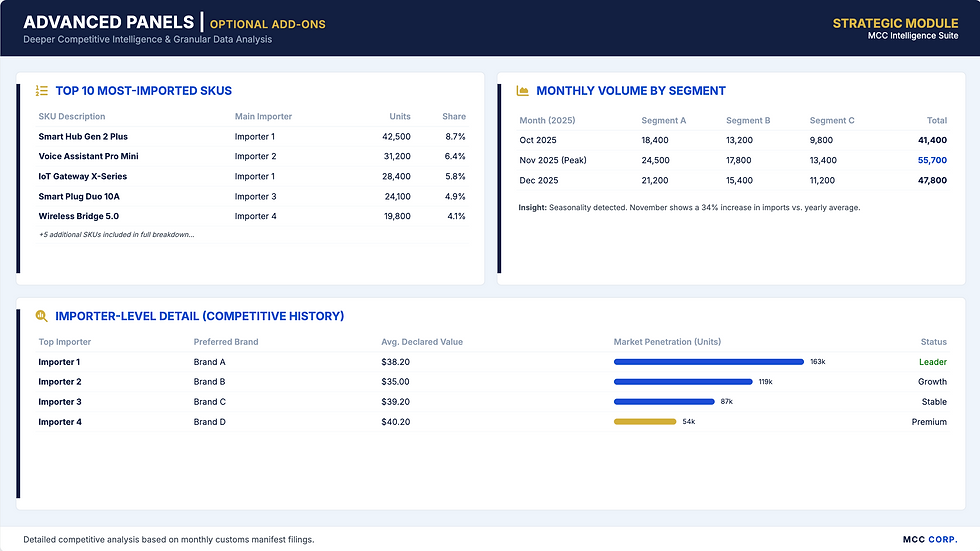
Full importer identification: who is actually bringing product into the market, at what volumes, and at what declared FOB values
Category breakdowns by price range and product segment
Monthly import trends and seasonality patterns
The output is a structured dashboard: board-ready, filterable, and delivered within approximately one week for a base report.

This isn't only useful at entry
One of the more common situations we encounter is a brand that has been in the region for two or three years, has a distributor relationship in place, and is starting to wonder whether what they're being told reflects what's actually happening in the market.
The distributor reports look fine. But something doesn't add up. Growth is slower than it should be. The brand's presence at retail feels thinner than expected. Products are showing up in channels nobody authorized.
For brands in that position, a one time report is useful, but ongoing visibility is more valuable. MCC Corp offers a subscription model with monthly dashboard updates from the latest available customs data, allowing a brand to track competitor import activity, detect market share shifts, and identify grey market flows as they happen rather than after the damage is done. A brand that loses digital and channel share of voice in LATAM can take significantly longer to recover it than to maintain it in the first place.
Two things we hear before most studies get commissioned
"It's probably too expensive at this stage"
A base Market Intelligence Report starts at USD 1,200 for a six-month snapshot of a single country. A 12-month report with monthly breakdown capability is USD 2,000. For context, those figures represent a fraction of the cost of one miscalibrated pricing decision: an undetected Anti-Dumping Duty on a first container can represent USD 30,000 to USD 80,000 in unplanned cost. Retailer margins at players like Falabella and Cencosud run 35 to 55%, versus the 20 to 30% most HQ finance teams model. The study exists precisely to surface those gaps before they become expensive.
"I'm not sure that level of detail actually exists for LATAM"
It does, but not in any form a brand could access directly. The data requires proprietary database access, technical cleaning to resolve incorrect HS codes and inconsistent product descriptions, and commercial experience to interpret correctly. A raw customs record showing a competitor importing "electronic device, misc." at a declared value that looks implausibly low requires someone who knows the category, the importer, and the typical margin structure to understand what's actually happening. That context is what converts raw data into intelligence a commercial team can use.
What good intelligence makes possible
Knowing the real competitive landscape changes the quality of every decision that follows: which country to prioritize, which channel to lead with, whether the cost structure can actually compete before any inventory is committed.
It also changes the conversation with retail. Walking into a negotiation with retail, or a major marketplace with transaction-level data on category performance, competitor positioning, and price architecture is a different conversation than walking in with a global brand deck.
"The brands that tend to do well in Latin America aren't necessarily the ones with the biggest budgets. They're the ones that knew what they were walking into."
To request a report, share the product category, the country or countries, and the period you want to cover here. MCC Corp responds to all scoping requests within 24 hours.
About MCC Corp: We help international IT accessories and consumer electronics manufacturers enter and grow across Latin America, from market intelligence and pricing strategy to retail negotiations and full regional representation.


Comments